


Most people pick a travel credit card the same way they pick a streaming subscription. Something looks good, the sign-up feels easy, and the actual fine print gets read six months later when something doesn’t work as expected.
For working professionals who travel on weekends and want a card that keeps up with that lifestyle, the decision deserves more than five minutes. Here are eight things worth checking before you apply, and where most cards in India currently fall short on each one.
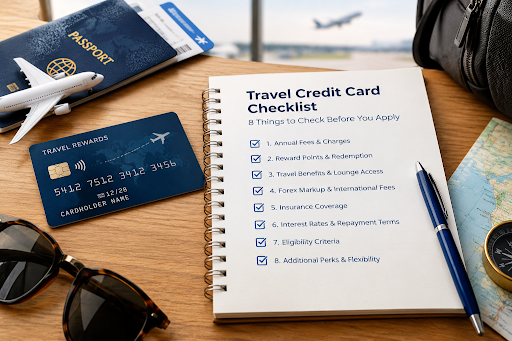
8 Things to Check Before You Applying Credit Card
1. Does it cost you anything before it gives you anything back?
The first filter is simple. Annual fees on travel credit cards in India range from ₹500 to ₹10,000 depending on the tier, which means you are paying before a single benefit kicks in. Most premium cards justify this through lounge access or milestone rewards, but for someone spending moderately and travelling a few times a year, the fee often cancels out whatever was earned. A lifetime free travel credit card changes the starting point entirely. Scapia is lifetime free across all three of its issuing partners, Federal Bank, BOBCARD and Axis Bank, with no joining fee and no annual renewal charge.
2. Is the zero forex markup actually zero?
The best credit card for international travel should not add anything on top of the network exchange rate. Most standard cards charge 3.5% plus GST on foreign currency transactions, which on a ₹2 lakh international trip adds roughly ₹7,000 in charges before you factor in anything else. What the best zero forex markup credit card delivers is a rate that matches the Visa or Mastercard network rate with nothing added. Cards like Scapia does this across 170+ countries, and the SmartForex feature inside the app shows real-time spending in local currency alongside INR, so there are no statement surprises when you return.
3. Does it earn on how Indians actually spend?
The best travel credit card for Indians needs to work for the 85% of spending that happens domestically, on groceries, dining, UPI payments, weekend purchases, not only on flight bookings. Most premium travel cards earn well on international hotels or airline spends and drop significantly on everyday categories. Scapia earns 10% back as Scapia Coins on all eligible domestic card spends, 20% on travel booked through the app, and 5% on UPI payments above ₹500 through Scapia Pay on the RuPay card. The earning is consistent across categories rather than front-loaded on travel alone.
4. How easy is the redemption in practice?
The gap between earning rewards and actually using them is where most travel rewards credit cards lose people. Airline mile transfers, partner portals, minimum redemption thresholds, points that convert to less than expected, these are standard friction points across legacy card programmes. Scapia Coins redeem directly at checkout inside the app against flights, hotels, trains, buses, visa applications across 40+ countries and curated travel experiences. No portals, no transfers, no ratio calculations. You can cover up to 100% of a booking with accumulated coins if you have enough.
5. Does it work at the airports you actually fly from?
Only 32 airports in India have lounges. If your card’s airport benefit is lounge access and nothing else, it delivers nothing at the other airports across the country. Scapia Airport Privileges work across 100+ domestic airports, giving you up to ₹1,000 back in coins on dining, shopping or spa at metro airports, ₹500 at smaller ones, regardless of whether a lounge exists there. For international departures, book a flight (T&C) through the Scapia app and unlock up to ₹2,000 back on duty-free shopping or dining at international terminals in India. This is the gap no other lifetime free travel credit card has addressed at this scale.
6. Is it genuinely useful abroad without a second card?
Carrying a best forex card alongside a credit card for overseas travel is a common workaround for people whose primary card charges markup. It adds unnecessary friction. The best credit card for overseas travel eliminates this by being the only card you need to carry internationally, handling foreign transactions without markup, earning on eligible domestic spends when you are home, and connecting to a full travel platform for every booking.
7. Who issues the card and what does that mean for approval?
Co-branded travel credit cards are approved and issued by the issuing bank, not the travel platform. The Scapia Federal Credit Card is now available through three issuing partners: Federal Bank, BOBCARD and Axis Bank, which joined in September 2026 running on Mastercard and RuPay. Each issuer runs its own credit assessment, which broadens the approval pool significantly. If a Federal Bank application was declined previously due to their one-card policy, the Axis Bank route is now a separate path with its own eligibility criteria.
8. Is the ecosystem connected or just a feature list?
The best travel credit card in 2026 should not stop at just being a payment instrument. It connects earning on daily life to booking the entire trip in one place, flights, trains, buses, hotels across domestic and international destinations, visa applications, experiences, and travel gear through the Scapia Store. The loop between spending on regular life and funding actual travel is what separates a card that works from one that looks good on paper. Scapia’s ecosystem is built entirely around closing that loop, which is why it is worth checking against this list before settling for a card that only partially delivers on it.